

Why Specialty Coffee Costs More Than Grocery
Table of Contents
- Specialty Coffee vs Commodity Coffee: The Core Difference
- Bean Quality and Grading Standards
- Coffee Supply Chain Transparency and Traceability
- Hand-Harvested and Labor-Intensive Processing
- Benefits of Freshly Roasted Coffee and Roast-to-Order Models
- Fair Trade Premiums and Producer Compensation
- Why Specialty Coffee Costs More: The Price Breakdown
- Conclusion
- Frequently Asked Questions
Last Updated: September 21, 2026
Specialty Coffee vs Commodity Coffee: The Core Difference
The gap between specialty coffee and commodity coffee isn't subtle, it's fundamental. Specialty coffee costs more than grocery store options because it's built on a completely different foundation: traceability, quality control, and intentional roasting. Commodity coffee, by contrast, is standardized, mass-produced, and designed for shelf stability above all else.
Specialty coffee typically scores 80 points or higher on the Specialty Coffee Association's cupping scale, while commodity coffee often scores in the 60s or lower. That gap reflects real differences in how the bean was grown, harvested, processed, and roasted.
The price difference starts at the farm. Specialty coffee requires hand-harvesting of ripe cherries and precise processing, costing far more than bulk commodity harvesting. The shorter, transparent supply chain means more money reaches producers and less is lost to middlemen.
Bean Quality and Grading Standards
Specialty beans have fewer than five defects per 300-gram sample, while commodity beans allow up to 86. This measurable difference reflects the Specialty Coffee Association's grading standards.
Specialty coffee undergoes cupping, where trained evaluators score flavor clarity, acidity, body, and balance. Commodity coffee skips this scrutiny; buyers purchase by price and basic specs, not flavor.
Single-origin coffees showcase regional flavor differences, Ethiopian coffee tastes distinctly different from Colombian or Brazilian due to altitude, soil, and climate. Commodity blends obscure these differences intentionally, prioritizing consistency over character.
Coffee Supply Chain Transparency and Traceability
When specialty coffee costs more than grocery alternatives, you're paying for transparency. Direct trade and fair trade models allow you to trace beans back to a specific farm, cooperative, or named farmer.
Commodity coffee moves through multiple intermediaries, exporters, importers, distributors, obscuring origin and growing conditions. No one in the final chain knows where the beans came from or how they were treated.
Specialty coffee's transparency ensures quality control and fair compensation. Direct trade relationships often pay producers two to three times the commodity price, creating incentives for better farming practices.
Specialty Coffee Association quality standards
Hand-Harvested and Labor-Intensive Processing
Ripe coffee cherries must be picked by hand during a narrow harvest window. A skilled picker harvests 100-200 pounds per day in steep, mountainous terrain, distinguishing ripe red cherries from unripe green and overripe black ones.
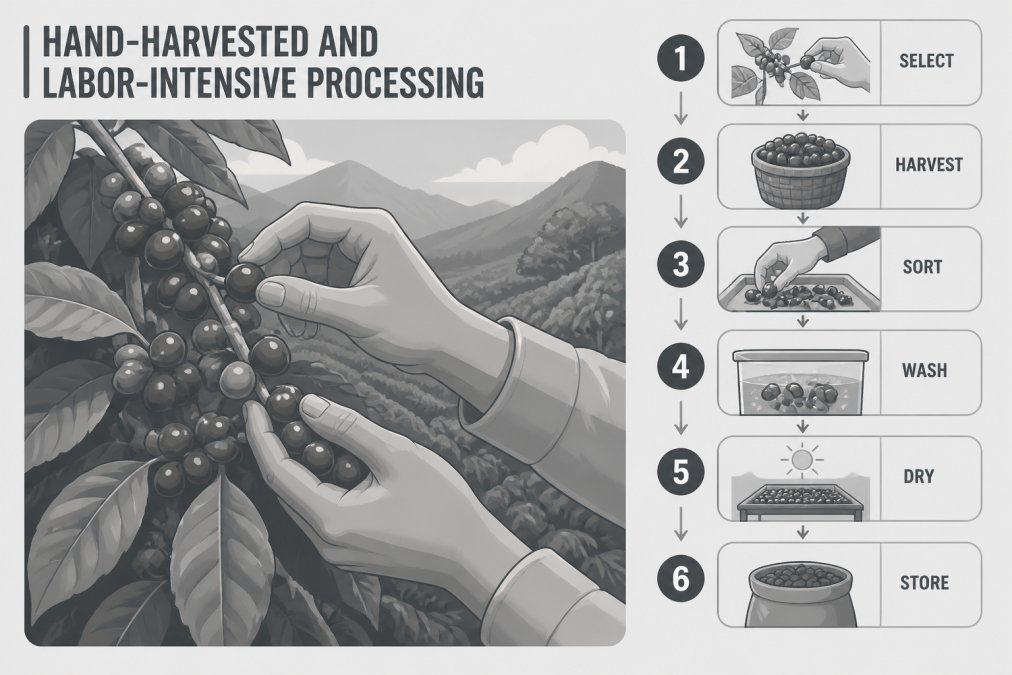
Specialty coffee undergoes careful processing: washed coffees ferment 12-72 hours then dry in sun or mechanical dryers; natural process coffees dry whole with fruit intact, requiring careful turning. Both demand attention and labor that commodity producers skip.
Micro-batch roasting roasts smaller quantities for precise flavor development, requiring more roasting runs and skill. The roaster adjusts heat and airflow based on bean density and moisture content. Commodity roasters use automated systems that prioritize speed over nuance.
Benefits of Freshly Roasted Coffee and Roast-to-Order Models
After roasting, coffee degasses for 24-48 hours, which is why specialty roasters recommend waiting 2-3 days before brewing. After that window, flavor degradation accelerates.
Coffee loses flavor through CO2 loss and oxidation. Research from the Specialty Coffee Association shows coffee loses approximately 50% of aromatic compounds within 2-4 weeks of roasting at room temperature, and exceeds 75% loss by 8 weeks.
Grocery store coffee is roasted 4-12 weeks before purchase, then sits on shelves another 2-4 weeks. By the time you brew it, most aromatic complexity is gone, producing a flat, one-dimensional cup. Consumers often compensate with more grounds or hotter water, over-extracting and masking the problem.
Roast-to-order models eliminate this problem. Beans are roasted after your order is placed and ship within 2-5 business days, arriving 3-7 days post-roast, the ideal window for most brewing methods.
The difference is tangible and immediate. A single-origin Ethiopian coffee roasted to order might reveal milk chocolate, blueberry, and caramel notes on the first brew. The same coffee purchased from a grocery shelf weeks after roasting tastes flat, slightly stale, and one-dimensional by comparison. Consumers often mistake this staleness for "not liking" the coffee, when the real issue is age.
Roast-to-order vs. retail specialty coffee: Not all specialty coffee is roast-to-order, and this distinction matters. Some specialty roasters sell through retail channels (grocery stores, coffee shops, online retailers) where the coffee sits in inventory for weeks. These coffees are fresher than commodity coffee but older than roast-to-order options. They typically cost $14-18 per 12-ounce bag and represent a middle ground: better than grocery, but not optimal freshness.
True roast-to-order specialty coffee costs $20-28 per 12-ounce bag and arrives at peak freshness. The premium reflects the operational cost of roasting smaller batches on demand rather than in bulk. However, the freshness advantage justifies the cost for consumers who prioritize flavor. A roast-to-order coffee brewed within 7 days of roasting will taste noticeably brighter, more aromatic, and more complex than a retail specialty coffee that's 3-4 weeks old.
Storage also matters. Even roast-to-order coffee degrades if stored improperly. Whole beans should be kept in an airtight container away from light, heat, and humidity. Ground coffee degrades even faster, within 15-30 minutes of grinding, most aromatic compounds begin to escape. This is why whole-bean specialty coffee is always superior to pre-ground, regardless of freshness at purchase.
Fair Trade Premiums and Producer Compensation
Here's what specialty coffee costs more than grocery: producers in specialty supply chains earn dramatically higher compensation. Fair trade certification guarantees a minimum price floor, typically around $1.40 per pound, compared to commodity prices that often hover below $1.00. Direct trade relationships often pay even more, sometimes $2.00 to $4.00 per pound depending on quality and relationship.
This premium matters enormously in coffee-producing regions where farming families often live in poverty. Higher prices allow farmers to invest in better equipment, improve farming practices, and send children to school. The incentive structure changes when farmers know they'll be paid fairly for quality coffee. They invest in their farms, experiment with processing methods, and focus on producing exceptional beans.
Commodity coffee's race to the bottom creates perverse incentives. Farmers are pressured to maximize volume, not quality. They harvest everything at once, mix in unripe and overripe cherries, and use minimal processing care. The system rewards quantity over excellence, which naturally produces inferior coffee.
When you buy specialty coffee, you're not just paying for better flavor. You're supporting farming communities and incentivizing sustainable practices. That's a real component of why specialty coffee costs more, and it's a legitimate one.
Why Specialty Coffee Costs More: The Price Breakdown
Understanding why specialty coffee costs more requires looking at the actual economics, and that starts with understanding how commodity coffee prices are set. The vast majority of coffee traded globally is priced on the Intercontinental Exchange (ICE) using the "C-market" (or "C-price"), a futures contract that sets a baseline price for commodity-grade coffee. This price fluctuates daily based on global supply and demand, weather events, and currency movements, but it has historically hovered between $0.80 and $1.50 per pound over the past decade. Grocery store coffee is typically sourced at or near this C-price, which means retailers can offer it cheaply because the underlying commodity is cheap.
Specialty coffee operates outside this system entirely.
- Green bean cost: $2.50-4.00 per pound (specialty sourcing premium)
- Roasting, packaging, and labor: $1.50-2.00 per pound
- Roaster margin and overhead: $1.00-1.50 per pound
- Retail markup (if applicable): $0.50-1.00 per pound
ICE Futures U.S. coffee contracts and pricing
Conclusion
The question of why specialty coffee costs more than grocery store coffee has a straightforward answer: specialty coffee is built on a foundation of quality, transparency, and care that commodity coffee simply doesn't prioritize. From hand-harvested beans to fair trade compensation to roast-to-order freshness, every element of the specialty coffee supply chain requires investment and expertise.
Frequently Asked Questions
What is the difference between specialty coffee and grocery store coffee?
Specialty coffee is graded at 80+ points on a cupping scale, comes from single-origin or micro-batch sources, and is roasted fresh to order. Grocery store coffee is commodity-grade, often a blend of lower-quality beans, mass-produced months in advance, and stored on shelves where it loses flavor and aroma. Specialty coffee prioritizes traceability, bean density, and sensory attributes; commodity coffee prioritizes shelf-life and cost reduction.
Does paying more for specialty coffee actually guarantee better quality?
Yes, when sourced from reputable roasters. Higher specialty coffee prices reflect verifiable quality markers: cupping scores, direct trade or fair trade certification, single-origin traceability, and freshness guarantees. Roast-to-order models like RMR Coffee ensure beans arrive at peak flavor. Check for transparency about origin, processing method, and roast date to confirm the premium reflects actual quality, not just marketing.
Why does freshly roasted coffee cost more than pre-roasted grocery coffee?
Freshly roasted coffee maintains flavor clarity and aroma for weeks after roasting; grocery coffee loses these sensory attributes within days of roasting due to long storage and shipping. Roast-to-order models require smaller production batches, faster logistics, and quality control at every step, all of which increase costs. The premium pays for maximum flavor and a superior brewing experience that grocery coffee cannot deliver.
How much of the specialty coffee price goes to farmers and producers?
Fair trade and direct trade specialty coffee ensures producers earn 2-3 times the C-market commodity price. While exact percentages vary by roaster, transparent supply chain practices mean farmers receive meaningful compensation for their labor-intensive harvesting and processing. This producer compensation is factored into specialty coffee pricing and directly supports sustainable farming practices and farmer welfare.
The true cost of specialty coffee isn't a premium, it's an investment in flavor, ethics, and the daily ritual that fuels your adventures. Start with RMR COFFEE's sample packs and discover why specialty coffee costs more, and why it's worth every penny.