

How to Tell If Coffee Beans Are Fresh: 2026 Guide
Table of Contents
- Why Freshness Changes Everything About Your Cup
- The Coffee Bloom Test: Your Fastest Freshness Check
- Coffee Roast Date Importance: Reading the Label Right
- How to Store Coffee Beans for Freshness at Home
- Sensory Signs: Aroma, Oils, and Taste That Reveal Stale Beans
- How to Tell If Coffee Beans Are Fresh: A Step-by-Step Checklist
- Common Mistakes That Ruin Fresh Coffee Beans
- Conclusion
- Frequently Asked Questions
Last Updated: September 19, 2026
Why Freshness Changes Everything About Your Cup
Fresh coffee beans make the difference between a flat, forgettable cup and one that wakes up your senses. At RMR COFFEE, we roast every batch only after you order, because freshness is the single biggest factor you control. Learning how to tell if coffee beans are fresh protects your money and your mornings.
Freshly roasted beans hold volatile oils that carry aroma and flavor. Once exposed to air, those oils begin to fade. Oxygen starts breaking them down within days.
That decline is why roast date matters more than almost any label on the bag.
The good news: you do not need lab equipment to spot the difference. Your eyes, nose, and a simple pour of hot water will tell you plenty.
Below, we break down the exact signals, plus the storage habits that keep beans at their best.
Specialty Coffee Association freshness guidance
The Coffee Bloom Test: Your Fastest Freshness Check
The coffee bloom test is the quickest way to judge freshness at home. Pour hot water over fresh grounds and watch what happens. Fresh beans release trapped carbon dioxide, forming a bubbling dome of foam.
That bubbling is called degassing, and it is a good sign.
Here is how to run the test:
- Grind two tablespoons of beans medium-coarse.
- Place the grounds in a mug or pour-over cone.
- Pour hot water just off the boil over the grounds.
- Watch for 30 seconds.
A big, active bloom means the beans still hold gas and flavor. A weak or flat bloom suggests the coffee has been sitting a while.
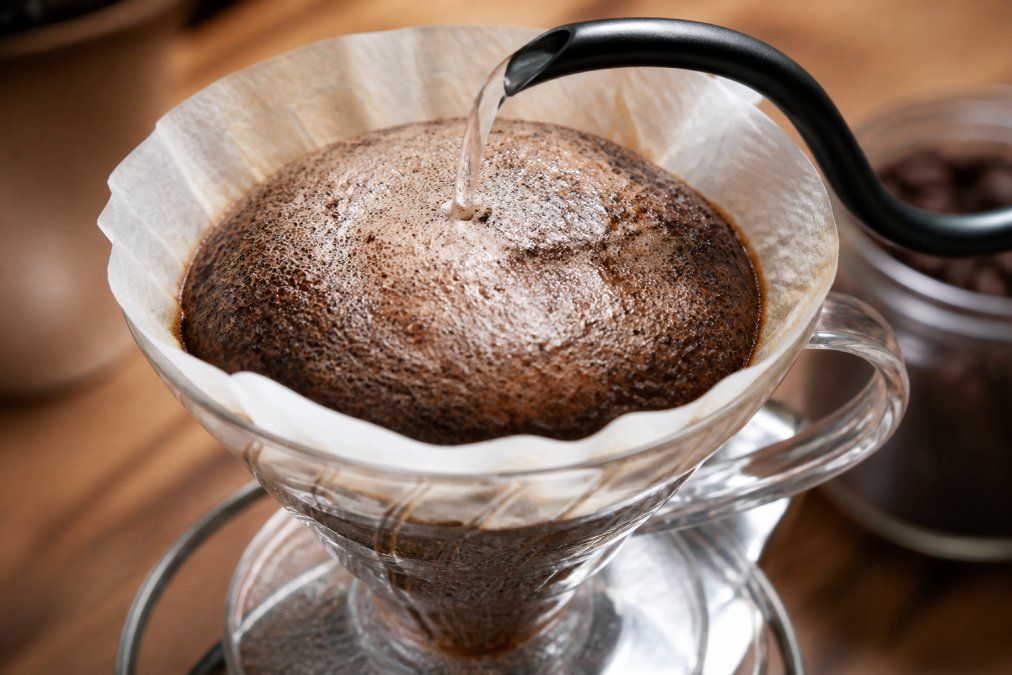
Why the Bloom Happens: The Degassing Process
Roasting transforms green coffee through heat, pressure, and chemical reactions. One byproduct is carbon dioxide, which gets trapped inside the bean's porous cell structure. After roasting, that CO2 slowly escapes, a process called degassing. Most of it leaves within the first few days, but trace amounts keep releasing for two to four weeks.
When hot water hits the grounds, it accelerates that release. The CO2 pushes water away, which is why a fresh bloom foams up and a stale one barely reacts. The gas is also why freshly roasted beans taste flat or sharp if you brew them too soon, the CO2 interferes with extraction. Many roasters recommend resting beans 3 to 7 days after the roast date before brewing, and the bloom is your visual confirmation that the rest period is working.
Roast Level Changes the Bloom
One caveat: dark roasts degas faster than light roasts. So a dark roast may bloom less even when it is still fresh. Dark beans spend longer in the roaster at higher temperatures, which cracks the cell walls further and releases more CO2 up front. A dark roast at day 10 may bloom like a light roast at day 20. Judge the bloom against the bean's roast level, not against a universal standard.
The Packaging Myth: Why a Flat Bag Does Not Mean Stale Coffee
Most quality bags ship with a one-way degassing valve, a small circular disc, usually on the front or back panel. The valve lets CO2 escape so the bag does not balloon and burst, but it blocks outside oxygen from entering. That means a bag that arrives flat is not necessarily stale. It may simply have finished its initial degas before shipping.
A puffed-up bag is a stronger freshness signal than a flat one, but neither is definitive.
Coffee Roast Date Importance: Reading the Label Right
Coffee roast date importance comes down to one rule: buy by roast date, not by expiration date. A roast date tells you when the beans left the roaster. An expiration date tells you almost nothing useful.
Most bags show one of three labels:
- Roast date: the most helpful stamp you can find
- Best by date: often set months out, so it hides real age
- No date at all: a warning sign on its own
How to Store Coffee Beans for Freshness at Home
Knowing how to store coffee beans for freshness matters as much as buying well. Four enemies ruin beans fast: air, light, heat, and moisture. Each one attacks the bean differently, and understanding the mechanism helps you prioritize.
How Each Enemy Works
Oxygen drives oxidation, the same reaction that turns a sliced apple brown. Coffee oils, the compounds carrying aroma and flavor, react with oxygen and break down into stale, papery, or rancid-tasting molecules. Oxidation starts the moment the bean is exposed to air and never stops.
What Actually Works
Here is what works:
- Keep beans in an airtight container, not the open bag
- Store away from light, so a dark cupboard beats a countertop jar
- Skip the fridge, where moisture and odors creep in
- Buy whole beans and grind just before brewing
A one-way valve on the bag helps beans release carbon dioxide without letting oxygen in. Once you open the bag, that protection drops sharply. If you keep beans in the original bag, press out excess air and seal it tightly. If you move them to a container, choose an opaque, airtight one and fill it to minimize headspace.
Roast Level Changes the Storage Clock
Dark roasts and light roasts do not age at the same rate. Dark roasts have more porous cell structures from longer roasting, so they degas faster and oxidize faster. A dark roast may taste noticeably flat within two to three weeks, while a light roast can hold up for four to six weeks under good storage. If you buy dark roasts, buy smaller quantities more often.
Freezing: When It Helps and When It Hurts
A common pattern is to portion beans into single-week bags before freezing. That way you thaw only what you will use, and the rest stays sealed and cold.
Sensory Signs: Aroma, Oils, and Taste That Reveal Stale Beans
Your senses catch staleness before any label does. Start with smell. Fresh beans hit you with a bright, sweet fragrance the moment you open the bag. Stale beans smell dull, papery, or faintly like cardboard.
Then taste. Stale coffee shows up as:
- A hollow, flat flavor with no depth
- A papery or rancid edge
- Weak acidity and thin body
- None of the fruit, chocolate, or nut notes you expect
How to Tell If Coffee Beans Are Fresh: A Step-by-Step Checklist
Here is a fast checklist to run before you brew. It takes about two minutes.
- Check the bag for a clear roast date
- Confirm the roast date is recent
- Smell the beans: bright and sweet, or dull and papery?
- Look for heavy oily residue and a faded color
- Squeeze a bean: fresh beans feel firm, not brittle
- Run the bloom test and watch for bubbling
- Taste a small cup and note the flavor
| Signal | Fresh Beans | Stale Beans |
|---|---|---|
| Aroma | Bright, sweet | Dull, papery |
| Bloom | Active, foamy | Flat, little foam |
| Surface | Light sheen | Heavy oil, faded |
| Taste | Full, layered | Hollow, flat |
| Roast date | Recent | Old or missing |
Common Mistakes That Ruin Fresh Coffee Beans
Plenty of well-meaning habits quietly wreck fresh beans. Here are the ones we see most.
Conclusion
Judging freshness takes minutes once you know the signs. Check the roast date, smell the beans, run the bloom test, and store them right. Those habits protect every cup you brew.
USDA guidance on food storage and shelf life
Frequently Asked Questions
What is the 15-15-15 rule for coffee?
The 15-15-15 rule is a simple guideline for storing coffee beans: keep them at 15°C (59°F), use them within 15 days of the roast date, and grind them no more than 15 minutes before brewing. While the temperature and timing are approximate, the principle holds: coffee beans fresh from the roaster lose their best flavors quickly when exposed to heat, air, and moisture. Following this rule helps you enjoy a more vibrant, aromatic cup every time.
How does the coffee roast date affect flavor?
The coffee roast date importance cannot be overstated. Beans hit peak flavor about 4 to 14 days after roasting, once they finish degassing. Before that, carbon dioxide can interfere with extraction, causing sour or uneven tastes. After 3 to 4 weeks, oxidation sets in, and flavors turn flat, papery, or rancid. Always check the roast date, not just a best-by date, because it tells you exactly where the beans are in their flavor window.
Are 2-year-old coffee beans still good?
Two-year-old coffee beans are not good for drinking. Even in an unopened, vacuum-sealed bag, roasted beans lose most of their volatile oils and aroma compounds within a few months. After two years, the beans will taste hollow, papery, or rancid, and no brewing method can bring back the lost flavor. For the best cup, use beans within 2 to 6 weeks of the roast date and store them properly.
Do coffee beans lose flavor if stored in the freezer?
Freezing can preserve coffee beans fresh for up to 2 months if done correctly. Use an airtight container or vacuum-sealed bag to prevent moisture and freezer odors from seeping in. Never thaw and refreeze beans repeatedly, as condensation degrades the oils. For daily use, keep a small supply at room temperature in an opaque, airtight container and freeze the rest in single-use portions.