

Does Altitude Affect Coffee Brewing? A Guide
Table of Contents
- How Altitude Changes Water's Boiling Point and Extraction
- The Science: Atmospheric Pressure and Coffee Extraction
- How to Brew Coffee at High Altitude
- Best Grind Size for High Altitude Brewing
- Impact of Elevation on Coffee Bean Density and Flavor
- Troubleshooting Common High-Altitude Brewing Failures
- Frequently Asked Questions
Last Updated: September 23, 2026
How Altitude Changes Water's Boiling Point and Extraction
At higher elevations, water boils at lower temperatures because atmospheric pressure decreases with elevation, allowing water molecules to escape as steam more easily. This is the fundamental challenge for coffee brewing at altitude.
At sea level, water boils at 212°F. At 5,000 feet elevation, water boils at around 202°F. At 10,000 feet, it drops to approximately 194°F. This matters enormously for coffee extraction.
Coffee extraction depends on heat. Cooler water extracts more slowly and incompletely, resulting in under-extracted coffee that tastes weak, sour, or thin.
This is why does altitude affect coffee brewing is such a critical question for mountain residents and high-elevation travelers. RMR COFFEE's blends are designed to be bold and smooth enough to handle both early mornings on the trail and long days at altitude, accounting for the extraction difficulties that come with lower boiling points.
The Science: Atmospheric Pressure and Coffee Extraction
Atmospheric pressure decreases with elevation: 14.7 psi at sea level, 12.2 psi at 5,000 feet, and 10.2 psi at 10,000 feet. Lower pressure allows water molecules to escape as vapor more easily, so kettles reach boiling temperature faster at altitude, but the water itself is cooler than at sea level.
Why Lower Atmospheric Pressure Matters
Extraction efficiency drops when water temperature falls. When your brewing water is 10-18°F cooler than sea-level brewing, you're leaving flavor on the table because certain compounds dissolve best at higher temperatures.
Thermal energy available to dissolve solids is lower at altitude; molecules move slower in cooler water, so contact time must increase to compensate.
Solubility and Thermal Energy at Elevation
Solubility depends heavily on temperature. At altitude, cooler water means fewer coffee compounds dissolve into your cup, leaving a narrower flavor profile and less body.
Thermal energy drives the chemical reactions that create flavor by breaking down cell walls and accelerating molecular movement. When thermal energy is limited at altitude, these processes slow down, making brew time adjustments non-negotiable.
How to Brew Coffee at High Altitude
Brewing excellent coffee at altitude requires adjusting temperature, water chemistry, brew time, and grind size together.
Understanding Water Chemistry at Altitude
Atmospheric pressure affects water's ability to dissolve minerals and coffee solids.
Adjusting Water Temperature for Your Elevation
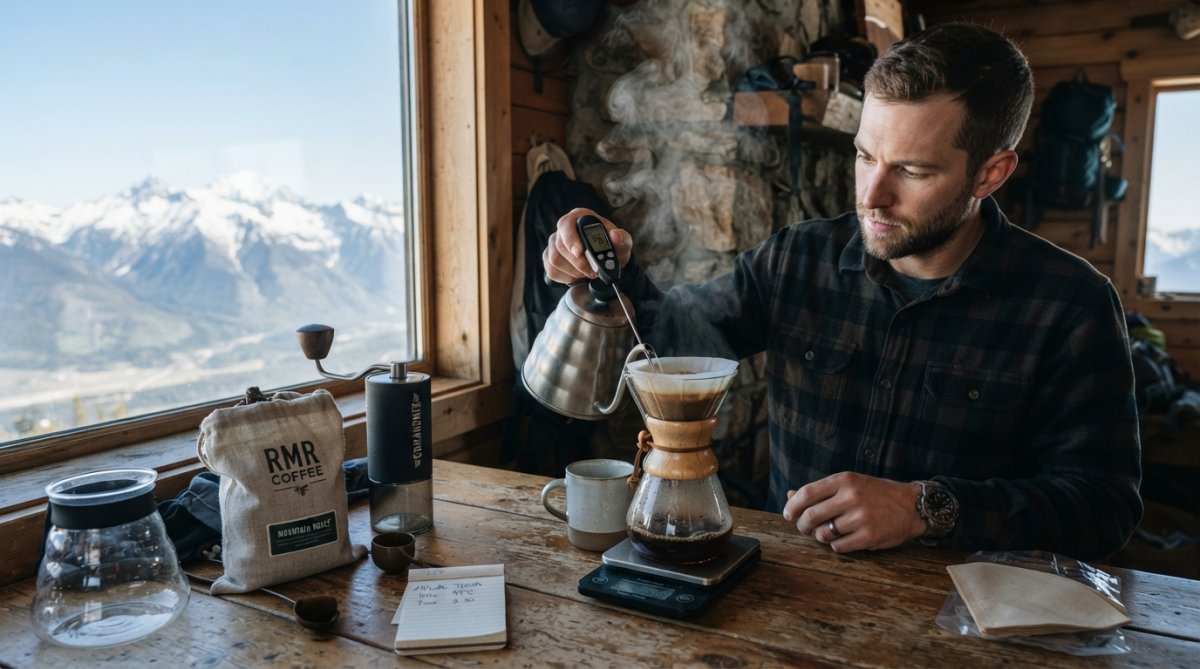
Heat water to 200-205°F at 5,000 feet elevation using a reliable digital thermometer. If using a stovetop, remove water from heat about 30 seconds before a rolling boil to prevent overshooting.
Pre-heat your brewing vessel with hot water before brewing, then discard. Heat loss is more significant at altitude, so every degree matters.
Brew Time and Contact Time by Method
Pour-Over: Increase brew time by 1.5-2 minutes (3-4 minutes at sea level becomes 5-6 minutes at 5,000 feet). Slow your pour rate to extend contact time evenly.
French Press: Extend steep time by 50-100% (4 minutes at sea level becomes 6-8 minutes at altitude). Stir gently after 30 seconds, then let steep undisturbed.
AeroPress: Increase steep time from 1-2 minutes to 2-3 minutes. The pressure step remains the same.
Espresso: Increase shot time from 25-27 seconds to 28-32 seconds. If the shot exceeds 35 seconds, your grind is too fine.
Cold Brew: Cold brew eliminates boiling point issues. Steep for 12-18 hours in room-temperature water; extended contact time naturally compensates for lower water temperature.
Brew Ratio Adjustments
At altitude, increase your brew ratio from 1:16 to 1:15 or 1:14 (more coffee, less water). This 6% increase in coffee dose often resolves weakness that time and temperature adjustments alone cannot fix.
Integration: A Practical High-Altitude Brew Protocol
- Test your water hardness. If above 200 ppm, filter it. If below 30 ppm, use mineral water.
- Heat water to 200-205°F (use a thermometer).
- Pre-heat your brewer with hot water; discard.
- Grind one setting finer than your sea-level baseline.
- Brew using extended time: +1.5-2 minutes for pour-over, +2-4 minutes for French press, +30 seconds for espresso.
- Taste and adjust: If sour, grind finer or extend time. If bitter, grind coarser or reduce time. If weak, increase coffee dose by 10%.
- Record your settings (grind size, brew time, temperature, elevation) so you can replicate success.
This integrated approach addresses the physics (boiling point, atmospheric pressure) and chemistry (water hardness, solubility) of high-altitude brewing simultaneously.
Best Grind Size for High Altitude Brewing
Grind size is your most powerful lever for altitude adjustment because it directly controls surface area exposure and water contact time. However, the right grind size depends on your brew method, elevation, and bean density, not a one-size-fits-all rule.
Grind Size by Brew Method at High Altitude
Pour-Over (Chemex, V60, Melitta): Start one to two settings finer than your sea-level baseline. If you normally brew medium (roughly 0.75 mm particle size), move to medium-fine (0.5-0.6 mm). At 5,000+ feet, this finer grind accelerates extraction in your 5-6 minute brew window without causing channeling, because the extended brew time compensates for increased resistance. Watch your pour rate: finer grinds slow water flow, which is actually beneficial at altitude. If water pools on the surface or drips very slowly, you've gone too fine; back off one setting. If your cup tastes sour after 6 minutes, grind finer by 0.1 mm increments until the sourness resolves.
AeroPress: Grind to medium-fine (0.6-0.7 mm), slightly finer than sea-level recipes. The AeroPress's immersion-then-pressure method is forgiving at altitude because you control brew time precisely. Increase your standard steep time from 1-2 minutes to 2-3 minutes, then apply pressure. Finer grinds here actually reduce the pressure required to push water through, which matters if you're brewing at 7,000+ feet where atmospheric pressure is noticeably lower. If your cup is weak, increase grind fineness before increasing coffee dose.
French Press: Keep your grind coarse (1.0-1.5 mm), similar to sea level. French press relies on immersion time, not grind fineness. Instead of grinding finer, extend your steep from 4 minutes to 6-8 minutes. Finer grinds in a French press increase sediment and can create a gritty mouthfeel; the coarse grind + longer time approach yields cleaner cups at altitude.
Espresso: Grind 0.1-0.2 mm finer than your sea-level setting. At altitude, your espresso machine's pump must overcome lower atmospheric pressure, which reduces the effective pressure differential. A finer grind increases resistance and helps the pump achieve proper extraction pressure. Target a shot time of 28-32 seconds (slightly longer than sea-level 25-27 seconds).
Why Grind Size Matters More Than Temperature Alone
Temperature adjustments are limited, you can only heat water so hot before it damages the coffee's flavor. Grind size, by contrast, can be adjusted in small increments and has a wider effective range. A 0.1 mm change in grind fineness can shift extraction by 5-10%, while a 2°F temperature change shifts it by roughly 2-3%.
The Channeling Trap
The most common mistake is grinding too fine in pour-over setups. Extremely fine grinds (under 0.4 mm) create a dense cake that water cannot penetrate evenly. Water finds paths of least resistance and channels through the grounds, bypassing most of the coffee. You end up with under-extracted, sour coffee despite a long brew time.
Dialing In at Your Elevation
Start conservatively. Use your sea-level grind as a baseline, then shift one setting finer. Brew a cup and taste it. If it's sour or thin, grind finer by 0.05-0.1 mm. If it's bitter or harsh, grind coarser by the same increment. Record your final grind setting and elevation; this becomes your reference for future brewing.
Impact of Elevation on Coffee Bean Density and Flavor
Coffee grown at higher elevations is denser and more flavorful than lowland beans. Beans grown at higher elevations mature slowly, developing complex sugars and acids.
How Altitude Shapes Bean Growth and Development
Beans grown at higher elevations mature slowly, developing more compounds. Higher-elevation beans are denser with less water content, requiring more aggressive extraction. Specialty coffee typically comes from 1,200-2,200 meters elevation. At altitude, where water is cooler, you need extended brew time to extract their full complexity.
Sugar and Acid Development in High-Altitude Beans
Slower maturation creates more sugars and brighter acidity in high-altitude beans.
Troubleshooting Common High-Altitude Brewing Failures
Sour, thin coffee: Under-extraction. Increase temperature by 2-3°F, extend brew time by 30-45 seconds, or grind finer.
Weak, watery coffee: Increase coffee dose by 10-15%.
Frequently Asked Questions
Why does water boil at a lower temperature at high altitudes?
Lower atmospheric pressure at elevation allows water molecules to escape as vapor more easily. At sea level, water boils at 212°F, but at 5,000 feet, it boils around 203°F. This reduced thermal energy means water can't dissolve coffee solids as effectively, resulting in under-extraction and weaker flavor.
How do I brew coffee at high altitude to get better extraction?
Increase water temperature by 5-10°F above your normal brew, extend contact time by 30-60 seconds, and use a slightly finer grind to increase surface area. These adjustments compensate for lower atmospheric pressure and help achieve the solubility needed for full flavor development.
What is the best grind size for high altitude brewing?
Use a slightly finer grind than you would at sea level. Finer particles increase surface area for diffusion, allowing water to extract more flavor precursors and acidic compounds in the shorter time available before under-extraction occurs. Test with a medium-fine grind and adjust based on taste.
Does altitude affect the flavor of coffee beans themselves?
Yes. High-altitude coffee plants mature more slowly due to cooler temperatures, developing denser beans with higher sugar and chlorogenic acid content. This creates more complex flavor profiles with greater acidity and sweetness. Beans grown at elevation often taste brighter and more nuanced than lower-altitude beans.